
Caddo Projected and Actual Release
“Projected release date” is the exact term used by Louisiana DPS&C, followed by the key qualifier “if applicable.” It is a current calculation based on the information the custodian has received. An actual release date records that a custody episode ended. The two dates may match, but only the later release entry proves that staff completed discharge.
A person awaiting trial usually has no fixed sentence-based date. A bond may be set, yet bond set does not mean bond posted. A judge may order release, but another warrant, case, detainer, or transfer can keep custody in place. For a sentenced person, the court supplies the term and jail credit while CPSO or DPS&C performs the authorized calculation. Those roles should not be combined.
Scheduled vs actual: A Caddo Parish projected release date forecasts a possible exit. Confirm the event with an actual CPSO or DPS&C release record.
- Projected date
- A calculated future date that can change as records, credits, penalties, or holds change.
- Actual release
- The recorded end of one agency's custody episode.
- Detainer
- A request or legal hold that may route the person to another custodian instead of the community.
- Discharge
- The formal end of the sentence or supervision scope identified by the record.
Find a Caddo Projected Date
Begin with legal custody. Someone at Caddo Correctional Center can be a local pretrial detainee, a parish-sentenced prisoner, or a DPS&C prisoner housed locally. The correct date source follows that authority, not merely the building. Shreveport City Jail reports are booking sources, and a move from city custody to CCC is a transfer rather than release.
- Identify the person with full name, date of birth, SO or DPS&C number, booking number, and court case when available.
- Check the CPSO current roster. Presence means current parish custody; absence alone proves nothing.
- For a state-sentenced person, call the DPS&C locator at (225) 383-4580 with a DPS&C number or name plus date of birth. Ask if the date is projected or actual.
- For a parish sentence, request the CPSO calculation or release record and review First Judicial District Court sentencing minutes for the term and credit.
- If the calculation is incomplete, use DPS&C time-computation information at (225) 342-0799. Do not supply your own release date.
- On or after the projected day, obtain the actual movement or release entry and ask whether the outcome was community release or transfer.
The Caddo Parish released-inmate record path covers the later confirmation step. It pairs the jail or state record with the court authority instead of treating roster absence as release.
Caddo Release Dates Before 2024
Louisiana law splits date calculations by offense date. For older offenses, R.S. 15:571.3 contains several good-time, or diminution, rates and exclusions. Diminution is a lawful reduction in the custodial term for eligible time and conduct. It is not one statewide percentage that fits every person.
An eligible parish prisoner sentenced without hard labor may earn 30 days of diminution for each 30 days in actual custody. A first crime-of-violence conviction has a different three-days-per-seventeen-days rate. Specified DPS&C categories use other ratios, including thirteen days for seven days actually served in certain nonviolent cases, with lower ratios for violent or repeat categories. Classification, hard-labor status, prior history, and exclusions control.
CPSO or the superintendent has statutory authority over specified parish computations, while DPS&C computes state categories. The First Judicial District Court establishes the sentence and credit. A family estimate may help frame a question, but it cannot replace the authorized calculation.
The sentence record must be read for more than its total length. Concurrent terms run together to the extent the judgment directs, while consecutive terms run one after another. Hard-labor status, a suspended part, probation, and jail credit can each affect which office computes the date and what happens after physical release. Recommendations in a judgment are not the same as binding orders. Obtain the signed minutes or commitment before questioning the custodian's figures.
Note: Ask which offense-date statute and custody category were used when a Caddo Parish estimate differs from the official projection.
Caddo Release Date Change Factors
A projection changes when the inputs change. DPS&C may be waiting for official sentencing papers before it can compute a recently sentenced person's date. Later discipline, a new court order, an amended sentence, or a hold can alter what was once accurate. A parole result adds another legal path but does not itself prove the date the person walks out.
| Factor | Possible effect | Record to check |
|---|---|---|
| Sentencing paperwork | Calculation may remain unavailable until official documents arrive | Court commitment and DPS&C computation |
| Concurrent or consecutive terms | Changes how multiple sentences combine | Sentencing minutes and master record |
| Good-time award or forfeiture | Can move the projected date earlier or later | CPSO or DPS&C calculation record |
| Program credit | May add authorized credit for an eligible person | DPS&C record and governing statute |
| Detainer or new case | May prevent community release or cause a transfer | Movement record, warrant, and court docket |
| Parole decision | May create a conditional path after required steps | Committee result and later release entry |
Disciplinary forfeiture is governed by R.S. 15:571.4. Escape, recalculation, or receipt of corrected paperwork can also move a date. When two official sources disagree, record when each was checked and ask the calculating custodian for the current basis.
Confirm Caddo Parish Release Dates
The Louisiana Automated Victim Notification System can be searched by location, name, and ID/case number. Its official description covers imprisoned people and active probation or parole supervision, with updates every 24 hours. It does not promise that every fully discharged person stays in a permanent public archive. Read a prison assignment, community-supervision result, transfer, and release as different events.
The official DPS&C inmate information page is also the source for the telephone “projected release date (if applicable)” field.
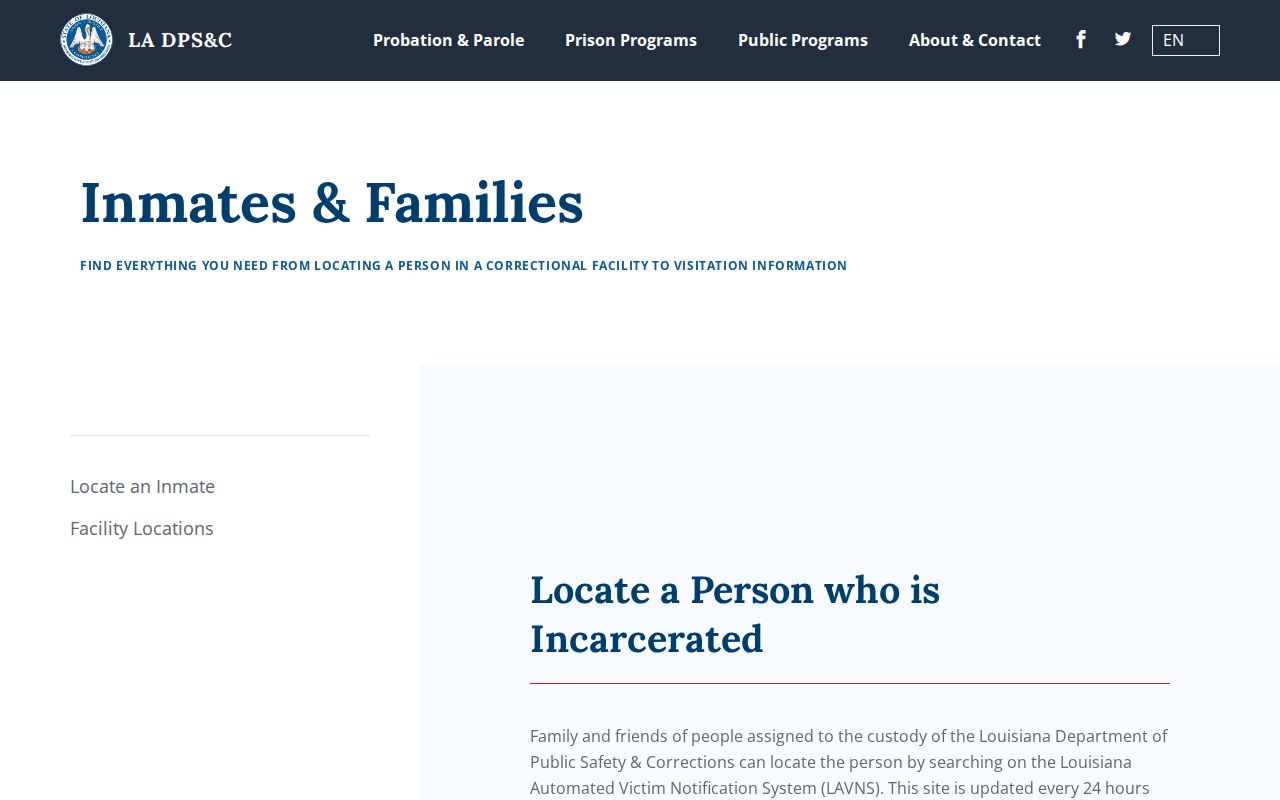
The screen points users into the state location system and identifies the supported phone details. It does not turn every displayed date into an actual release.
For a pending custody change, the Caddo VINELink release check can provide an alert. Preserve the event wording and source agency, then recheck CPSO, DPS&C, or the court. An alert prompts verification; it is not a certified release record.
Note: LAVNS updates every 24 hours, so a newer custodian record may resolve a date or status that has not yet appeared.
Caddo's 85 Percent Date Limit
Louisiana's August 1, 2024 offense-date split makes a simple online calculator unsafe. For eligible felony offenses committed on or after that date, R.S. 15:571.3.1 caps ordinary good-time diminution at 15 percent of the imposed sentence. That is the basis for an “about 85 percent” shorthand. It is not a universal rule for all Caddo Parish inmates.
The statute excludes sex offenders and habitual offenders. It also says no good time accrues on presentence custody credited under Code of Criminal Procedure article 880. Additional diminution may be available under R.S. 15:828 for eligible non-sex-offense cases, and credits may be forfeited. Older offenses remain under materially different categories and ratios.
Parole is separate from good time. For older offenses, R.S. 15:574.4 contains categories and exceptions. For offenses on or after the cutoff, R.S. 15:574.22 broadly limits parole while retaining enumerated special classes. A sound Caddo Parish projection needs the offense date, conviction, every sentence, presentence credit, eligibility class, program credit, forfeiture, holds, and official computation.
Important: Do not apply 85 percent to every sentence. Ask DPS&C or CPSO which statute, exclusion, and credit record controls.
Caddo Good-Time Release Status
A good-time release can have different supervision consequences based on the governing date and law. R.S. 15:571.5 traditionally describes release by diminution as release as if on parole for the rest of the full term, with a certificate and conditions. The newer framework includes unsupervised-parole treatment for many post-cutoff good-time releases and coordinates probation in a split sentence.
That distinction changes how a later search should be read. An active Shreveport district assignment supports supervised community status, but the lack of one does not prove that the person remains incarcerated. Ask for the release certificate, actual release date, and stated supervision status. Use the law for that offense and release, not a broad label.
A transfer from CCC to another prison is never good-time release to the community. Nor is placement in Caddo's transitional-work program. The actual movement record must say what authority ended and whether another custodian received the person.
Caddo Parish and State Date Paths
A local release calculation and a state calculation may concern people in the same Caddo Correctional Center building. Louisiana's parish-custody model permits state-sentenced people to remain in a local facility. A local pretrial booking, parish sentence, and DPS&C sentence therefore require different records even when the roster shows the same physical location.
For a local pretrial matter, review bond orders, dismissal, recognizance release, and other First Judicial District Court actions. None creates a projected sentence date by itself. Ask CPSO whether an order was executed and whether another hold remained. For a parish sentence, seek the total term, jail credit, authorized diminution calculation, and actual CPSO release or transfer entry.
For a DPS&C sentence, use the state number, official computation, prison movement record, and any parole action. LAVNS can show prison or community-supervision status, yet the audited source does not promise a public historical discharge field for every case. If a person has fully discharged, request the DPS&C release certificate or master-record portion and compare it with the court sentence.
Resolve Caddo Release Date Conflicts
Conflicting dates often refer to different events. A court order date is when legal authority changed. A projected date is the custodian's forecast. A parole grant is a conditional decision. A transfer date ends one custody assignment, and an actual release time ends the named custody episode. Label each date before deciding that two sources disagree.
Preserve the URL or request channel, check time, person identifier, exact status wording, and the agency whose custody is described. Then ask the calculating custodian for the inputs and any later recalculation. If the court sentence was amended, include the later signed order. If a hold appears, identify the receiving agency rather than reporting community release.
For CPSO records, use the official records-request channel and seek the booking number, release or movement date and time, disposition, and destination. For DPS&C, request the projected-date calculation, actual release or discharge entry, certificate, and supervision assignment. This focused record set usually explains the gap without relying on unsupported arithmetic.
Note: A source checked yesterday can be stale today, so attach a query time to every pending Caddo Parish release date.