
No Caddo 72-Hour Release Feed
Caddo Parish Sheriff's Office publishes a Currently Housed Inmates roster, not a rolling three-day release list. The verified interface offers filters tied to current inmates, including last-name initial and sex, with sorting by name, age, and booking date. None of those controls selects people released during the prior 72 hours. No other audited CPSO navigation supplied a dedicated release URL.
This negative finding controls the search method. A three-day result has to be requested from the records custodian by actual release timestamp. Sorting current inmates by booking date cannot answer who left custody. Nor can the absence of a name. A person who disappears from the roster may have gone to Louisiana DPS&C, another parish, a hospital, or a different custodian. Only the release disposition resolves that question.
Define Caddo's Three-Day Window
“Last 72 hours” can mean a rolling interval ending at the moment of the query. It can also be used loosely for three named calendar dates. Those boundaries are not equal. Caddo Parish records should be requested with a start, end, and time zone, using America/Chicago for local official operations. Ask the custodian to select events by the actual Release Date/Time field rather than booking time, entry time, or the time a record was later entered.
A well-bounded request might cover a Friday afternoon through Monday afternoon. Another might cover three full calendar days ending at midnight. Neither should be described as the agency's own 72-hour reporting method because CPSO publishes no such method. State the interval used whenever the results are discussed, and retain the agency response so the selection rule remains clear.
For a truly same-day question, use the narrower Caddo Parish released last 24 hours workflow. The three-day method is best when the period crosses several days or when the exact day is uncertain.
Request Caddo 72-Hour Releases
The CPSO records-request page provides an online form and a PDF template. It asks for requester contact details, permits a custodian category such as Criminal Records, and has a narrative field for a precise description. Ask for release events from Caddo Correctional Center during the stated interval. If the intended scope includes another Caddo Parish program, name it instead of assuming all facilities share one report.
- Set the beginning and ending date and time in Central Time, then label the range as rolling or calendar based.
- Identify the facility and request selection by actual release timestamp.
- Seek legal name, booking number, booking date and time, release date and time, disposition, and receiving agency or destination when recorded.
- Ask whether a coded outcome means community discharge, state transfer, another jurisdiction, or some other continued custody.
- Keep the request and response together so later verification uses the same 72-hour boundary.
A request for one person can be narrower. Add aliases, date of birth, SO number if known, and the approximate booking date. The agency may not hold or disclose every requested element, but enough identifiers reduce false matches and help locate the correct custody episode.
Note: CPSO has not published a special cadence or guaranteed response format for a three-day release report.
Caddo 72-Hour Release Fields
There is no official Caddo Parish three-day table whose columns can be promised. The current roster and its booking-history feature establish some fields, while the rest belong in a custodian request. A response should be read in three layers: identity, the specific booking episode, and its outcome. This avoids joining an old release time to the wrong current booking.
| Field | Use in the three-day review |
|---|---|
| Legal name and identifiers | Distinguish the correct person from a namesake; the roster visibly includes name, age, and sex. |
| Booking number | Ties all dates, charges, and outcomes to one custody episode. |
| Booking date/time | Shows when custody began, but does not qualify an event for the release window. |
| Release date/time | The key field for deciding whether the episode falls inside the defined 72 hours. |
| Disposition | Explains bond, time served, court order, sentence completion, parole, transfer, or another outcome. |
| Destination or agency | Separates community release from movement into continued custody. |
Bond does not mean the case ended. Parole means prison custody ended under community supervision. Probation is a court-ordered community sentence or condition and differs from parole. Transfer means custody continued. A receiving-agency field can be decisive when the person moved from the Caddo Correctional Center into the state corrections system.
Caddo Weekend Release Review
A three-day interval is useful for a weekend review because it keeps multiple dates in one request. Still, no Caddo Parish source promises a special weekend publication schedule, holiday delay, or fixed roster refresh hour. CPSO says its information changes quickly, is updated periodically, may contain errors, and may not reflect the present state. “Periodically” cannot be restated as hourly, daily, or real time.
Use the event time rather than the day someone noticed the roster change. Court minutes may establish that a judge authorized release, reduced bond, dismissed a count, or imposed time served. They may not show the exact moment CPSO completed discharge. Pair that legal authority with the jail release timestamp. If an order came late in the period but execution fell beyond the ending time, the event belongs outside that specific 72-hour set.
A release alert can also arrive after a custody change because participating agencies send data on their own schedules. Preserve the alert wording and delivery time, then confirm the event with the agency record. This is especially important when the notice says transfer, since transfer is not freedom from custody.
Caddo Release History Quirk
Caddo's roster provides partial historical visibility. When a person is currently listed, an expandable booking history may show older Booking Numbers, Booking Date/Time entries, and exact Release Date/Time entries. A current episode can instead be marked “*In Jail*.” That arrangement can confirm a prior discharge for a person who later returned, but it does not produce all parish releases over any three-day period.
Online retention is also unknown. Old entries visible in sample histories prove that some data have remained in the system, not that every release stays public for a fixed term. CPSO has published neither an online retention rule nor an exact refresh interval. A person-specific historical match is therefore evidence for that episode only. It cannot be used to estimate how complete the overall web archive may be.
The official request screen shows the channel used when the roster cannot answer the three-day question. Review the CPSO public-records form before drafting the date range.
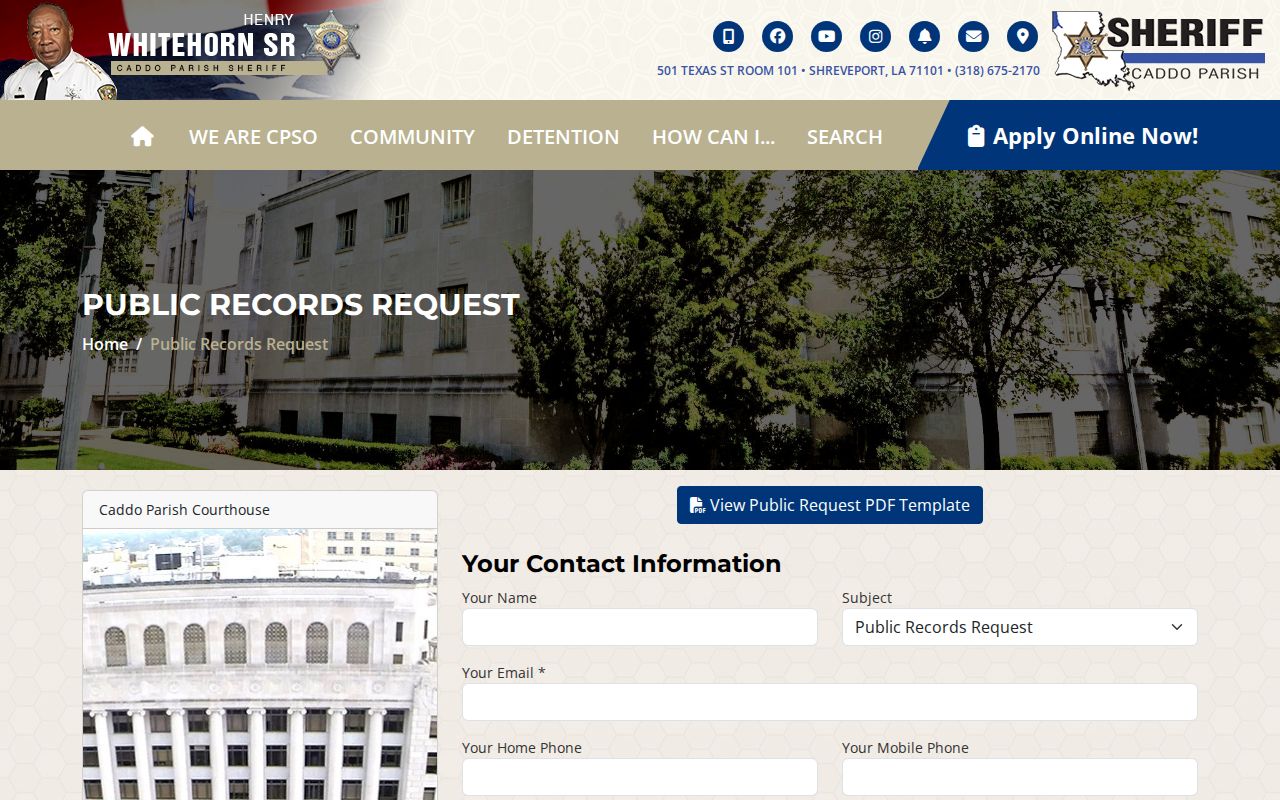
The form supports a bounded request to the custodian; it does not create an automated recent-release feed.
Confirm Caddo Three-Day Releases
Match the follow-up source to the type of custody. For a local pretrial episode, compare CPSO's actual release entry with the First Judicial District Court or Caddo Clerk disposition. If the person began in Shreveport City Jail, the city's daily reports establish booking, not release. Check whether the person moved onward to CCC before reaching a conclusion.
When the response names Louisiana DPS&C, search LAVNS by full name and another identifier when possible. A facility assignment means confinement continues. Active probation or parole supports community supervision, while a missing result remains inconclusive because the system updates on its own cycle and is not promised as a permanent archive for fully discharged people. VINELink is useful for a specific release or custody-change alert, but it does not replace the originating record.
Caddo court records can add the reason behind a release. The durable case file may show bond orders, minutes, dismissal, sentence, jail credit, probation, or revocation. It may not state the minute CPSO completed physical discharge. Use the court disposition to explain authority, then use the jail timestamp to place the event inside or outside the requested three-day period. That pairing is stronger than either record read alone.
For federal custody, use the Bureau of Prisons locator and federal case sources. For immigration custody, use the ICE locator and responsible office. Keep the final statement exact: released from CPSO, transferred to another agency, under community supervision, or not found at the stated query time. Those are different outcomes, and the 72-hour range does not erase those differences.