
Caddo Parole and Probation Compared
Parole and probation both let a person live in the community under rules, but they begin through different legal paths. A Caddo Parish parolee has left physical imprisonment on a conditional release set through Louisiana's parole process. A person on probation received a court-ordered community sentence, often with part of a sentence suspended. Neither status means a case vanished. Both may require reporting, travel limits, fees, programs, or other terms stated in the individual record.
The distinction matters when checking a released person. The DPS&C Probation and Community Corrections program administers community supervision, while the Louisiana Committee on Parole decides parole grants. The sentencing court creates probation. The state supervision result should be read with the court judgment or parole decision, not treated as a substitute for either.
| Point | Parole | Probation |
|---|---|---|
| How it starts | Conditional release after imprisonment | Court-ordered community sentence or suspended-sentence term |
| Decision source | Louisiana Committee on Parole under applicable law | The criminal court and its judgment |
| Local administration | DPS&C Shreveport District | DPS&C Shreveport District for state supervision |
| Best supporting record | Parole decision plus DPS&C release and supervision status | Sentencing minutes plus active supervision status |
- Parole
- Conditional community release after a period of imprisonment.
- Probation
- A court-imposed community sentence or condition tied to a suspended sentence.
- Discharge
- The formal end of a custody or supervision term, subject to the record's exact scope.
- Absconder
- A person alleged to have stopped reporting or complying, not a person newly convicted by that label alone.
Verify Caddo Post-Release Supervision
Louisiana uses LAVNS as its public person-location route. The official description says it covers imprisoned people and people under probation or parole, with updates every 24 hours. That coverage makes it useful for Caddo Parish supervision, but it is not promised as a permanent history after full discharge. Match more than a name whenever possible, since a false match can lead to a wrong conclusion.
- Start at the DPS&C inmate information page and follow the official LAVNS location link.
- Search by name, location, or ID/case number. Add a date of birth or DPS&C number when available.
- Read whether the result names a prison location, probation, or parole. A prison assignment means physical custody continues.
- Confirm that the listed district serves Caddo Parish. Contact the Shreveport district for the public confirmation it can provide.
- Compare parole with the decision and release record, or compare probation with the sentencing minutes. Do not infer an exit time from supervision status alone.
For a fully discharged person, LAVNS may return no durable public history. The right fallback is a DPS&C records request and the Caddo court record. For someone released only from Caddo Correctional Center and never placed under state authority, use CPSO and court records instead. The Caddo Parish released-inmate search path explains that county release route.
Important: A probation or parole result supports community supervision. It does not provide the actual Caddo Parish jail release timestamp.
Caddo Supervision at Shreveport District
The local office is the DPS&C Shreveport Probation and Parole District, which covers both Caddo and Bossier Parishes. It is the practical office to confirm that Caddo is within the correct service area and ask what public status information can be released. The official page does not promise officer-specific details or access to protected case material.
Shreveport Probation and Parole District2525 Youree Drive, Suite 300
Shreveport, LA 71104
(318) 676-7040
DPS&C Shreveport district office
Louisiana's published conditions call for a parolee to report no later than 48 hours after release and to submit a monthly report by the fifth. Those terms help explain why an active district assignment can corroborate a post-release status. They do not reveal the door-out time, and the precise conditions in the person's record control. The area's Day Reporting Center is a structured program contact point, not a jail and not a release archive.
Note: Call before visiting if the purpose is a records question, since the source does not publish general walk-in records hours.
Caddo Supervision Conditions and Violations
State conditions can include timely reporting, obeying lawful instructions, remaining within approved travel limits, and complying with program or case-specific rules. A claimed violation begins a process. It does not by itself establish a new crime, a conviction, or current jail custody. A supervision hold, warrant, preliminary hearing, revocation hearing, and final decision are distinct events that should be described separately.
VINELink may send a custody or supervision change alert for a participating record. Preserve the exact event language and originating agency. A transfer or supervision change is not the same as community release. Louisiana also maintains a separate Victim Outreach registration for certain DPS&C notices, so a local LAVNS registration should not be assumed to follow a person into every later state process.
When a possible violation changes the custody question, check the active warrant channel, the revocation docket, and the live custody source. Then obtain the underlying order or disposition. That sequence avoids turning an allegation into a final result.
Is Caddo Reentry a Release?
Caddo's local custody map includes the CPSO Re-entry and Transitional Work Program facility near Caddo Correctional Center. Placement there may allow structured work or program activity outside the main jail setting, but it remains custody or program placement. It is not final discharge. This distinction is easy to miss when a person has moved away from the main CCC custody area.
CPSO announced the facility's 2026 reopening after earlier periods of local operation. Official address references have also varied over time, including 1125 and 1121 Forum Drive. The earlier reentry announcement helps explain that change. Verify the current entrance by telephone rather than guessing from an old source. A final community release should be supported by the relevant CPSO or DPS&C record.
For a DPS&C prisoner housed locally, the governing custody record follows legal authority rather than the building. A move to transitional work remains a movement within the corrections system. Parole, good-time release, or full discharge requires its own later entry.
Caddo Warrants and Parole Absconders
CPSO's active-warrant lookup and Louisiana's parole-revocation dockets answer different questions. A CPSO hit means the person is wanted under the listed warrant. A revocation docket concerns alleged noncompliance by a person already released to supervision. Neither result alone proves that the person is incarcerated now.
No official public Caddo Probation and Parole absconder-name list was found. Use the state supervision result, the Shreveport district, CPSO warrant lookup, court record, and official revocation dockets as separate layers. Check the current CPSO roster only for present parish custody, not for proof of release.
The official CPSO warrant screen illustrates the distinction between wanted status and custody status.
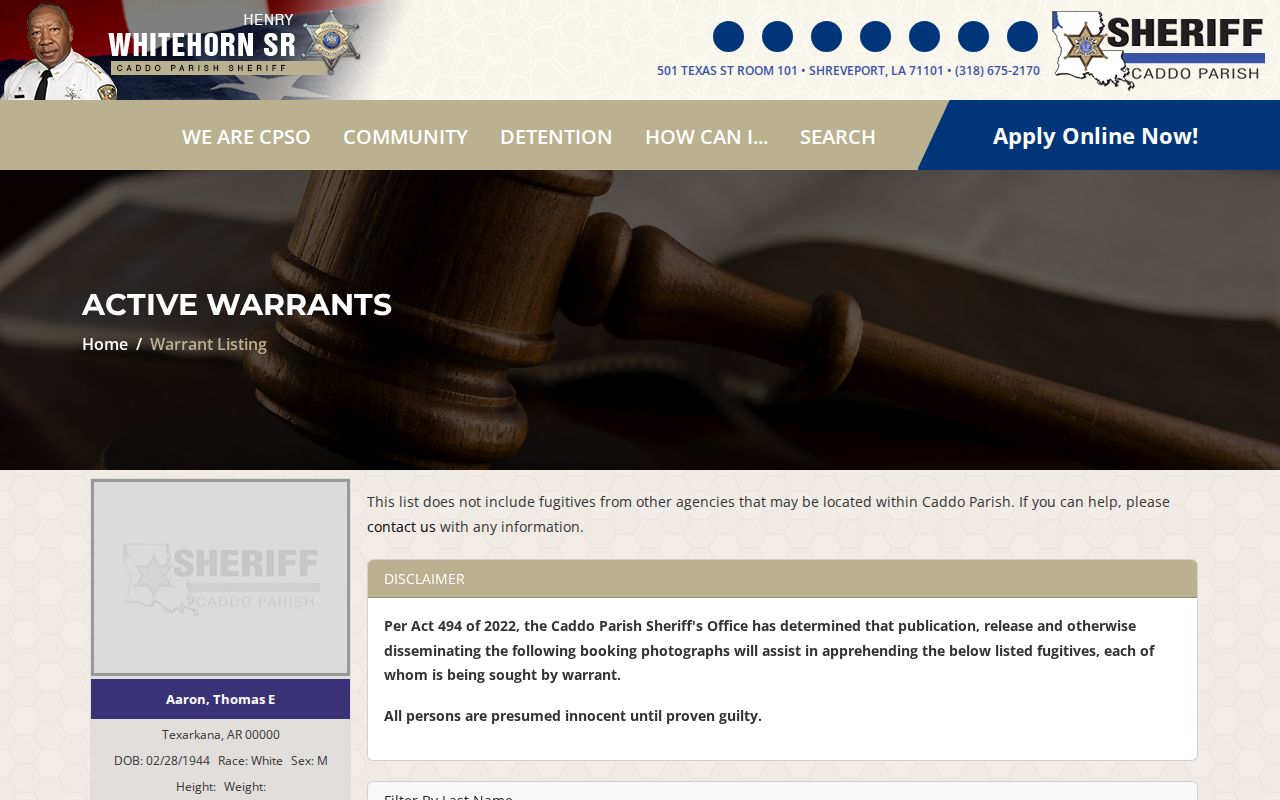
A photo or name there belongs to the warrant context. It is not a general supervision roster, and it should not be relabeled as a current jail record.
Note: If a warrant and supervision record conflict, preserve both query times and ask the issuing or supervising office for the current status.
Caddo Parole Decisions and Release
The Louisiana Committee on Parole is the sole parole-granting authority. The Board of Pardons handles clemency, which is a different function. Public parole hearings may be held by video or Zoom, and the official schedule page links hearing notices, agendas, dockets, results, and an archive. Eligibility may lead to a hearing, but it is not a promise of release.
A result should be reported with its exact wording. Supported outcomes include granted and denied, while official policies also address reconsideration, rescission, and revocation. A missing or postponed record should not be called deferred unless that term appears in the actual document. Even a grant does not show that the person physically left custody. Required notices, conditions, dates, or another hold can still affect the transition.
Offense date also matters. Parole eligibility under R.S. 15:574.4 differs from the broad post-August 2024 limits in R.S. 15:574.22. The conviction, sentence, criminal-history class, exclusions, and DPS&C calculation control. Charge name alone is not enough.
Note: A parole grant forecasts a conditional path; the later DPS&C release or supervision entry confirms whether the transition occurred.
Caddo Supervision Discharge Records
Supervision ends through a formal discharge, expiration, court action, or other authorized event shown in the governing record. A quiet or missing public search result is not enough. LAVNS is not promised as a permanent archive for everyone who has fully discharged, and public access may also change after a valid sealing or expungement order.
For parole, seek the DPS&C supervision and discharge record. For probation, review the sentencing court's minutes and later entries for completion, revocation, amendment, or discharge. The court may establish that a legal obligation ended, while the state record documents the supervision status. If a record is restricted, use the authorized custodian route and respect the limitation.
A complete status statement should distinguish three moments: the physical release from custody, the start of community supervision, and the later end of supervision. Combining them into one date can turn an accurate record into a false claim.
When requesting a historical record, provide the DPS&C number, conviction, facility, known release date, and Shreveport supervision assignment. Ask for the actual discharge date and status rather than a broad file. If probation came from a Caddo court, identify the docket and seek the sentencing and discharge minutes. Narrow identifiers help the custodian separate people with similar names and keep the answer tied to one supervision term.